
Choosing the right technology for your website does not start with the name of the technology itself.
Do not start by asking:
Should I choose Next.js?
Should I choose WordPress?
Do I need custom development?
The more important question is:
What does your project actually need?
Next.js website design can be an excellent choice if you need a fast, customized, scalable website, or one connected to external systems and APIs.
However, it may not be the best option if your project mainly needs easy content management, lower cost, and faster implementation.
In this article, we explain what Next.js is, its advantages and disadvantages, the difference between it, WordPress, and custom development, when you should choose it, and when WordPress or another solution may be better for your project.
What is Next.js?
Next.js is a framework built on React and is used to develop modern websites and web applications.
React helps build user interfaces.
Next.js adds important capabilities that improve website performance, organization, and user experience.
Some of the main capabilities of Next.js include:
- Building fast-loading pages
- Server-Side Rendering support
- Static Site Generation support
- Improved user experience
- Better code organization
- Connecting websites with APIs and external systems
- Building interactive interfaces
- Improving website indexing in search engines
In simple terms:
Next.js is suitable when you need a customized interface, strong performance, and greater control over how your website and user experience are presented.
Why Consider Next.js Website Design?
You choose Next.js website design when your website is more than just informational pages.
Next.js is more suitable for projects such as:
- High-performance websites
- Digital platforms
- Saas
- Technical websites
- Dashboards
- Advanced online stores
- API-connected websites
- Interactive interfaces
- Unique user experiences
- Scalable future-ready projects
However, Next.js is not a magic solution.
The technology name alone does not guarantee speed, SEO, or success.
A poorly built Next.js website can still be slow and difficult to manage.
At the same time, a cleanly developed WordPress website can be fast, organized, and SEO-friendly.
The real difference lies in the implementation quality, not only in the technology name.
Features of Next.js Website Design
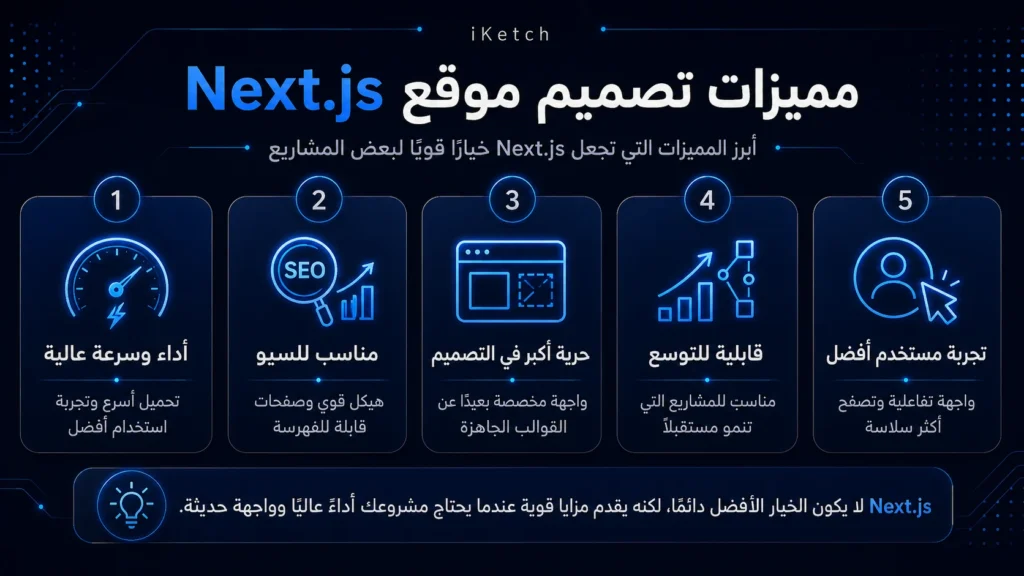
1. High Performance and Speed
One of the main reasons developers choose Next.js is its ability to build fast websites when implemented correctly.
Speed here does not only mean loading a page quickly.
It also includes:
- Faster content loading
- Better mobile experience
- Reduced waiting time for visitors
- Improved Core Web Vitals
- Lower bounce rates
- Better competitiveness in search engines
However, it is important to understand one thing clearly.
Next.js does not automatically make a website fast.
Unoptimized images, poorly structured code, weak hosting, or incorrect SEO implementation can all make a Next.js website perform below expectations.
2. SEO-Friendly When Properly Implemented
Next.js is considered SEO-friendly because it can generate pages that are easier for search engines to crawl and index compared to some traditional React applications.
It can be used to implement:
- Meta Titles for each page
- Meta Description
- Clean URL structures
- Indexable pages
- Sitemap
- Robots.txt
- Structured Data
- Fast-loading pages
- Fast-loading pages
However, SEO does not depend on Next.js alone.
SEO depends on:
- Helpful content
- Clear page structure
- Organized headings
- Internal linking
- Loading speed
- User experience
- Proper technical implementation
Technology provides the foundation.
But website quality comes from planning, execution, and content.
3. Greater Freedom in Front-End Design
Next.js gives developers a high level of flexibility when building website interfaces.
Every part of the website can be built based on the project’s actual needs, including:
- Custom homepages
- Unique service pages
- Non-traditional sections
- Interactive interfaces
- Smooth animations
- High-performance landing pages
- Fully customized user experiences
- Designs tailored to your visual identity
However, it is important to clarify one point:
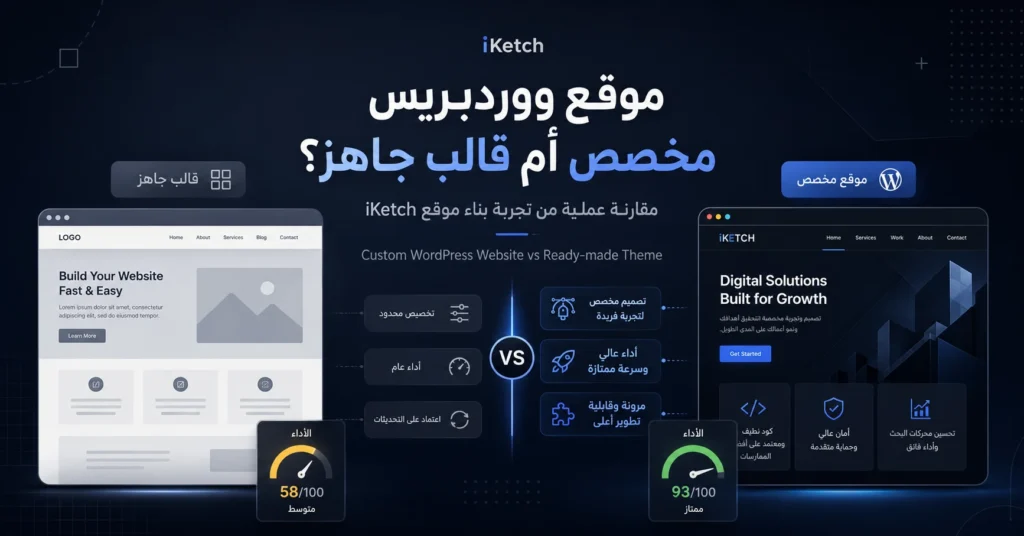
WordPress can also be implemented with a fully custom design from scratch.
WordPress does not necessarily mean using a ready-made template.
It is possible to build custom themes, use Tailwind CSS, develop custom Gutenberg blocks, or create a fully customized design that matches the project’s identity.
So the comparison is not:
Next.js means custom design
WordPress means ready-made templates
That is not true.
The real comparison should be between one implementation approach and another.
4. Suitable for Scalable Projects
If your project is expected to grow over time, Next.js can be a strong option.
For example:
- Connecting the website to a mobile app
- Integrating with a CRM system
- Using external APIs
- Building custom dashboards
- Creating digital platforms
- Membership systems
- Personalized user experiences
- Adding future features and integrations
In these cases, Next.js provides significant flexibility in front-end architecture and data handling.
5. More Interactive User Experience
Next.js is excellent for building smooth and interactive browsing experiences, especially when the website includes:
- Advanced search
- Filters
- User accounts
- Booking flows
- Checkout flows
- Interactive pages
- Real-time updates without page reloads
- Dashboards
- API-driven content
In these situations, the website becomes closer to a web application rather than a traditional static website.
Disadvantages of Next.js Website Design
Next.js is powerful, but it is not suitable for every project.
Before choosing it, you should understand its challenges.
1. Higher Development Cost
Next.js website development usually costs more than a basic WordPress website.
This is because the project often requires:
- Developers experienced with React and Next.js
- Custom interface development
- Structured code architecture
- Data integration
- Suitable hosting environments
- Technical SEO setup
- Performance testing
- Ongoing maintenance
For this reason, you should not choose Next.js simply because it is modern or popular.
Choose it when there is a real need for it.
2. No Built-In Content Management System Like WordPress
WordPress comes with a ready-to-use dashboard for managing pages, articles, and media.
Next.js does not include a built-in CMS in the same way.
If your website requires ongoing content management, you will usually need to connect it to a CMS such as:
- WordPress Headless
- Strapi
- Sanity
- Contentful
- Directus
- Payload CMS
This is not necessarily a disadvantage.
But it does mean the project may require better planning and a higher budget.
If your main goal is easy content management through a clear dashboard, WordPress may be the better choice.
3. Maintenance Requires Technical Experience
Next.js relies on modern tools and packages.
This means the website requires technical maintenance, updates, and ongoing support.
If the website does not use a CMS, you may need a developer for many content changes.
Even when using a CMS, the system must be configured properly to make management easy.
That is why maintenance and support should be considered from the beginning, not after launch.
4. It May Be More Than Your Project Needs
If your project is very simple, Next.js may be a larger solution than necessary.
For example, if you only need:
- A simple company website
- Service pages
- Portfolio pages
- Articles
- A contact form
- Easy content management
- A cost-effective solution
Then a professionally built custom WordPress website may be the smarter choice.
More advanced technology is not always the better decision.
Sometimes the simpler solution serves the project more effectively.
Next.js Website Design vs WordPress
This is an important question, but it should not become a battle between two technologies.
WordPress is not against Next.js.
And Next.js is not a replacement for WordPress in every situation.
Each technology has its own role.
When Should You Choose WordPress?
Choose WordPress if your project needs:
- Easy content management
- A large number of articles
- Service pages
- Portfolio pages
- A company website
- A traditional online store
- A non-technical team managing content
- Faster implementation
- Lower overall cost
But there is one important condition:
WordPress must be implemented properly.
The problem is not WordPress itself.
The problem is poor implementation.
Many clients think WordPress means a ready-made template, imported demos, too many plugins, and a slow website.
That is not true.
WordPress is a powerful platform.
A WordPress website can be fully custom-designed from scratch using a clean approach, minimal plugins, strong performance, and a proper SEO-friendly structure.
The final result depends on who builds the website, not simply on the fact that it uses WordPress.
When Should You Choose Next.js?
Choose Next.js if your project needs:
- Interactive interfaces
- High performance
- API integrations
- Digital platforms
- Advanced user experiences
- Scalability
- Full front-end control
- Features that do not fit traditional templates
- Separation between the front-end and content management system
Next.js becomes more valuable when the website itself is part of the product or the user experience, not just a simple informational website.
Can You Combine Next.js and WordPress?
Yes.
In many modern projects, the choice is not necessarily between Next.js and WordPress as competitors.
Sometimes the best solution is:
Next.js for the front-end
and WordPress for content management.
This approach is commonly called:
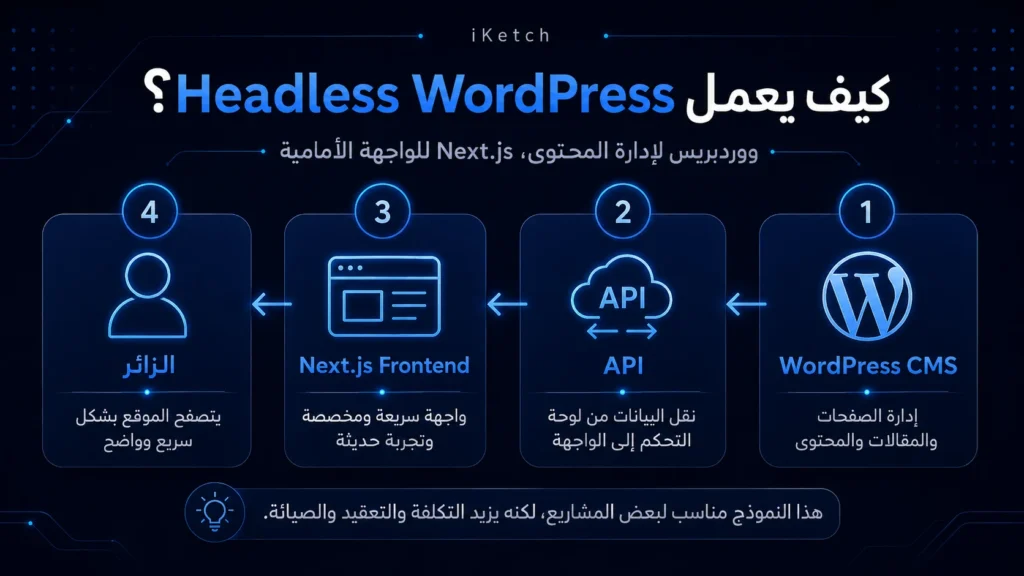
Headless WordPress
In this setup, the client uses the WordPress dashboard to manage content, while the website interface is built using Next.js.
This gives you:
- A familiar content management dashboard
- A faster and more customized front-end
- Separation between design and management
- More flexibility in user experience design
- Better scalability for certain projects
However, this solution is not suitable for every project.
Because it also increases:
- Cost
- Complexity
- Maintenance requirements
- Configuration difficulty
- The need for a team that understands WordPress, React, and Next.js together
For this reason, Headless WordPress with Next.js can be an excellent solution for some projects, but it should not be treated as the default choice for every website.
Comparison Between Next.js and WordPress
| Comparison Point | Next.js | WordPress |
|---|---|---|
| Main Use Case | Interactive and custom front-end experiences | Content management and easy-to-manage websites |
| Content Management | Requires external CMS or custom setup | Built-in dashboard |
| Design Flexibility | Very high front-end flexibility | Can be template-based or fully custom |
| Performance | Excellent when implemented properly | Also excellent with clean implementation |
| Cost | Usually higher | Usually lower depending on implementation |
| Maintenance | Usually requires developers | Easier for daily content management |
| SEO | Strong with proper technical setup | Strong with proper structure and settings |
| Best For | Platforms, interactive interfaces, Headless setups | Company websites, blogs, traditional stores |
Final Thoughts
If you need easy content management and frequent updates, WordPress may be the better option.
If you need interactive experiences, API integrations, and highly customized interfaces, Next.js may be the better choice.
And if you want both, you can combine WordPress and Next.js using a Headless setup when appropriate.
Next.js vs Custom Development
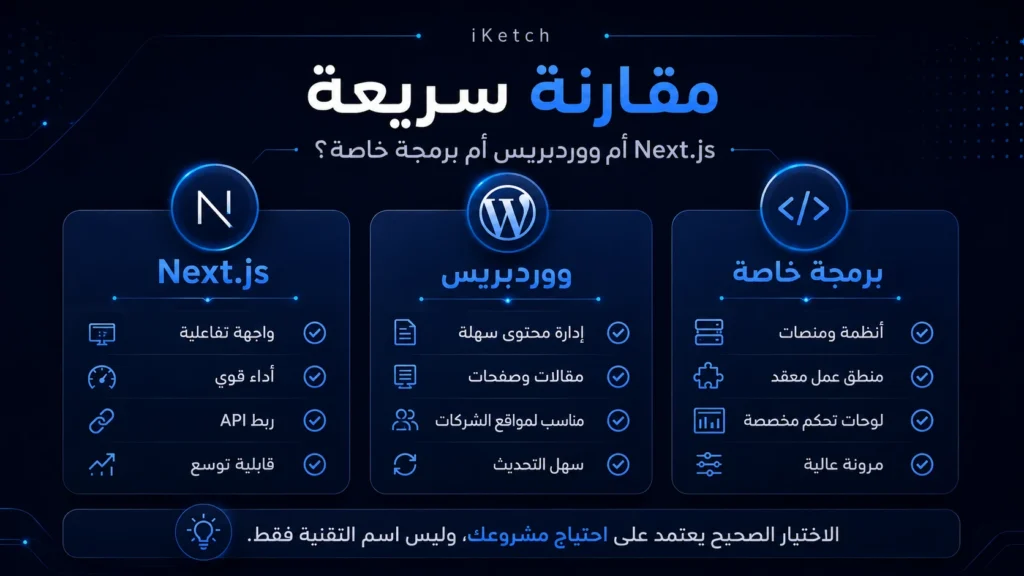
Many people confuse Next.js with custom development.
Next.js is part of the custom development ecosystem, but it mainly focuses on the front-end and user experience.
Full custom development may also include:
- Front-end interfaces
- Backend
- Databases
- Dashboards
- Permissions and roles
- User systems
- Payment systems
- APIs
- External integrations
- Internal business systems
If your project is simply a company website, you may not need full custom development.
But if your project is a platform or a system, you may need a custom backend alongside Next.js.
Simple examples:
A company services website
May work well with WordPress or Next.js with a CMS depending on the required management workflow.
A booking platform
May require Next.js with a custom backend.
An internal management system
Usually requires full custom development.
A traditional online store
May work perfectly with WooCommerce or Shopify.
A store with unique business logic
May require a fully custom solution.
So the real question is not:
Which technology is more powerful?
The real question is:
What does your project actually need?
Is Next.js Suitable for a Company Website?
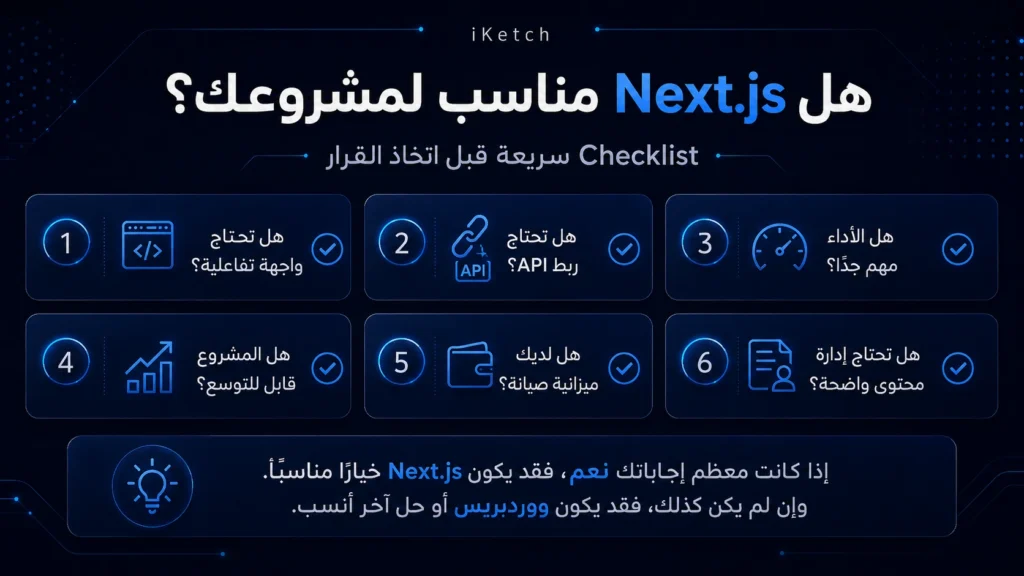
Yes, but it is not always necessary.
If your company needs a custom-designed website with high performance and a unique user experience, Next.js can be a strong choice.
However, if your website mainly consists of:
- A homepage
- Service pages
- Portfolio pages
- Articles
- Contact pages
Then a professionally built custom WordPress website may be the better option in terms of cost and ease of management.
And if you want the familiar WordPress dashboard combined with a modern front-end built using Next.js, then Headless WordPress may be a suitable solution.
At iKetch, we do not start with the technology name.
We do not start by asking:
Should we use Next.js or WordPress?
Instead, we ask more important questions:
- What is the goal of the website?
- Who is the target audience?
- Does the client need easy content management?
- Does the project require external integrations?
- Is the project expected to scale?
- Is the budget appropriate?
- Is the project a simple website or a platform?
- Does it require a custom user experience?
- Will it require ongoing updates after launch?
Only then do we choose the right technology.
Is Next.js Good for SEO?
Yes, Next.js can be very SEO-friendly when implemented correctly.
But websites do not rank in Google simply because they use Next.js.
To make a Next.js website SEO-friendly, you still need:
- Clear page structure
- Organized H1 and H2 headings
- Meta Titles for each page
- Meta Titles for each page
- Clean URLs
- Sitemap
- Robots.txt
- Structured Data
- Fast loading speed
- Optimized images
- Fast-loading pages
- Helpful content
- Internal linking
Next.js gives you a strong technical foundation.
But content quality, structure, and user experience are what make a website useful and competitive.
Cost of Next.js Website Design
The cost of a Next.js website varies from one project to another.
There is no single price that fits every case.
The final cost depends on factors such as:
- Number of pages
- Whether the design is custom or pre-made
- Whether the project requires a CMS
- Whether Headless WordPress will be used
- Multi-language support
- API integrations
- User accounts and authentication
- Dashboards
- E-commerce or payment systems
- Level of customization
- Hosting environment
- Post-launch support and maintenance
A simple Next.js website is completely different from a large-scale platform built with the same technology.
That is why pricing should always come after understanding the actual project requirements.
When Should You Avoid Next.js?
Do not choose Next.js simply because it is modern.
You may not need it if your project:
- Is very simple
- Has a limited budget
- Needs quick implementation
- Does not require advanced interactions
- Does not require external integrations
- Needs easy content management without developers
- Can be implemented faster and cheaper with WordPress
Do not choose a technology because it is trendy.
Choose it because it fits the project.
How Does iKetch Build Next.js Websites?
At iKetch, we treat Next.js website design as a customized solution, not simply as a trendy technology label.
We begin by understanding the project itself.
We study:
- Business type
- Website goals
- Target audience
- Content management workflow
- Required pages
- Scalability plans
- SEO requirements
- Budget
- Required integrations
- Level of customization
Then we determine whether Next.js is the right choice, or whether WordPress or full custom development would be better.
If Next.js is the right fit, we focus on:
- Designing interfaces that match your brand identity
- Building fast and mobile-friendly pages
- Structuring the website clearly
- Implementing technical SEO properly
- Connecting CMS systems when needed
- Implementing Headless WordPress when appropriate
- Integrating APIs and external systems
- Improved user experience
- Testing performance before launch
- Providing post-launch technical support
And if WordPress is the better option for your project, we say that clearly.
And if your project requires full custom development, we explain why before development begins.
Our goal is not to sell a specific technology.
Our goal is to build a website that truly serves your project.
Do You Need a Next.js Website?
If you are looking for a fast, modern, scalable website with a more advanced user experience, then Next.js may be the right choice for your project.
However, if your goal is a simple business website with easy content management, then a professionally built WordPress website may be the better solution.
And if your project requires a complete platform or system, then custom development may be necessary.
The important thing is not to start by asking:
Next.js, WordPress, or custom development?
Start by asking:
What does my project actually need?
Request a Consultation Before Building Your Website
Whether you need a Next.js website, a custom WordPress website, or a fully custom-developed platform, we can help you choose the right solution.
At iKetch, we design and develop websites for companies, online stores, and digital projects, with a strong focus on:Performance User experience SEO Mobile responsiveness Long-term support and maintenance
We do not choose technologies based on trends.
We choose them based on what truly fits your project.
If Next.js is the right fit, we will build it the right way.
If WordPress is the better option, we will implement it with a custom design and strong performance.
And if your project requires full custom development, we will explain the best approach before the project starts.
Contact us today and get a clear technical direction before starting your website.
Frequently Asked Questions About Next.js Website Design
Is Next.js Better Than WordPress?
Not always.
Next.js is stronger for projects that need interactive interfaces, API integrations, or highly customized experiences.
WordPress may be the better choice for websites that need easier content management and lower overall cost.
And in some projects, both can work together through a Headless WordPress setup.
Can WordPress Be Used With Next.js?
Yes.
WordPress can be used as the content management system while the website front-end is built with Next.js.
This setup works very well for certain projects, but it also requires more budget and maintenance compared to traditional WordPress websites.
Are Next.js Websites Fast?
Yes, they can be extremely fast when implemented properly.
However, speed still depends on: Code quality Image optimization Hosting quality Page structure Technical implementation
Is Next.js Good for SEO?
Yes, Next.js is SEO-friendly.
But it needs proper implementation of elements such as headings, links, meta tags, schema, sitemap, and site speed.
Can a Next.js Website Be Easily Managed?
Yes, when connected to a CMS such as: WordPress Headless Strapi Sanity
Without a CMS, many content changes may require developer involvement.
Is Next.js Website Development More Expensive Than WordPress?
In most cases, yes.
Because it usually requires: Higher technical expertise More customization More advanced front-end architecture
However, the final cost always depends on the project scope and requirements.
When Should I Choose Next.js Instead of WordPress?
Choose Next.js if your project requires: High performance Interactive interfaces API integrations Scalability Advanced front-end experiences
Is Next.js Suitable for Company Websites?
Yes, especially for companies that need a highly customized and modern website experience.
But if the website mainly needs easy content management and standard company pages, WordPress may be the better option.
Is Next.js a Complete Replacement for Custom Development?
Not always.
Next.js mainly focuses on front-end development and user experience.
Some projects still require: Custom back-end systems Databases Custom dashboards Business logic APIs
Do I Need Next.js Just to Get a Fast Website?
No.
Website speed depends on implementation quality.
A properly built WordPress website can be extremely fast.
And a poorly implemented Next.js website can still be slow.
Need the Right Website for Your Project?
Whether you need a Next.js website, a custom WordPress website, or a fully custom-developed solution, iKetch can help you choose the right approach based on your project goals, budget, and long-term needs.
We do not choose technologies because they are popular.
We choose them because they fit your project.
Start here:
Website Design & Development Services
Or learn more about:
iKetch Home Page