
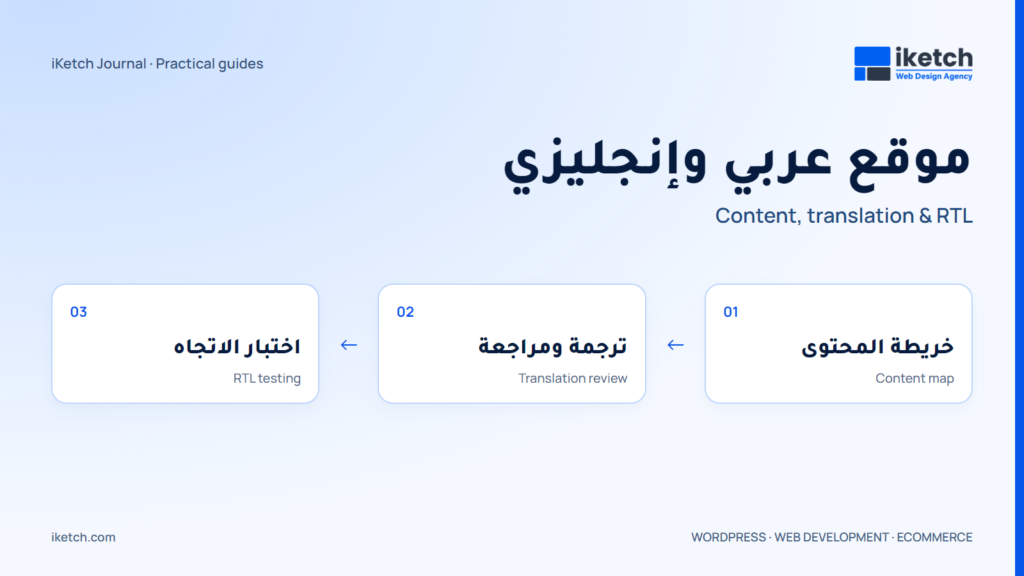
An Arabic and English website involves more than translating paragraphs. Headline length, number direction, page relationships, form messages and later content updates all need attention. Start with a map connecting each Arabic page to its English counterpart, then test the main journeys in both languages.
Map pages and content ownership
Create a table with each page name, its URL in both languages, its writer and reviewer, and the status of images and downloads. Include easily forgotten content: form confirmations, search results, error pages, downloadable files and customer emails.
- Are all services available in both languages?
- Which product and model names should remain unchanged?
- Who checks terminology, numbers and contact information?
- What happens to the translation when the original page changes?
A completed translation should be attached to an approved content version. Changing a price or service condition should trigger review of its counterpart, rather than leaving a previously approved translation untouched.
Review meaning before layout
Give the translator approved source content, audience context and preferred terminology. A button needs to communicate the same action, rather than reproduce the original word count. An English headline may need rewriting so it stays clear without shrinking the font for one language.
Review browser titles, descriptions, image text and links as well. Google’s localized versions guidance explains how hreflang connects equivalent language pages. That annotation supports translated content; it does not replace an English page’s main text remaining in Arabic.
RTL testing goes beyond alignment
Check a long page on mobile and desktop. Look at an Arabic heading containing an English product name, a price, a phone number and an email address. Some parts need their own natural direction within the Arabic page so that mixed text remains understandable.
- Navigation: menu order, submenu interaction, back controls and breadcrumbs.
- Content: heading wrapping, tables, lists, PDFs and words embedded in images.
- Forms: phone and email direction, validation messages and field names in notifications.
- Icons: directional navigation arrows may need mirroring; brand logos should retain their original form.
Switch languages from an internal page
Open a service or project and change language. The switch should lead to its equivalent, rather than always returning to the homepage. Check each version’s canonical URL and reciprocal hreflang links, and confirm that both URLs show the intended page instead of an unexpected redirect or error.
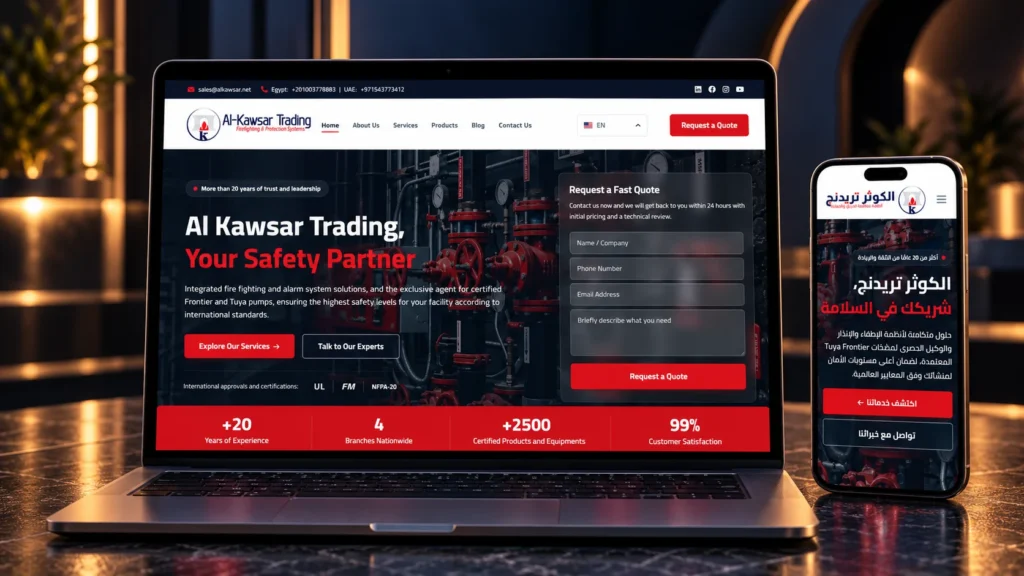
Our Al Kawsar Trading project provides a published example with three languages and a product enquiry structure. Leopard Catering provides another Arabic and English example. Each has its own content requirements; successful language switching alone does not establish translation quality.
If your delivery team is in another country, agree on remote website project coordination before entering content. The Al-Kawsar case study shows a multilingual example from iKetch’s WordPress website work.
Use a small acceptance record
For each test, record the page, language, device, result and reviewer. Include submitting a form, opening a project, downloading a file, switching language and editing content in the administration area. After launch, repeat affected checks when adding a service or changing navigation.
Before requesting an estimate, send your page map and available content. This helps us define the scope of a WordPress business website, assign translation responsibility and identify layouts requiring particular RTL testing before the final stage of the project.