
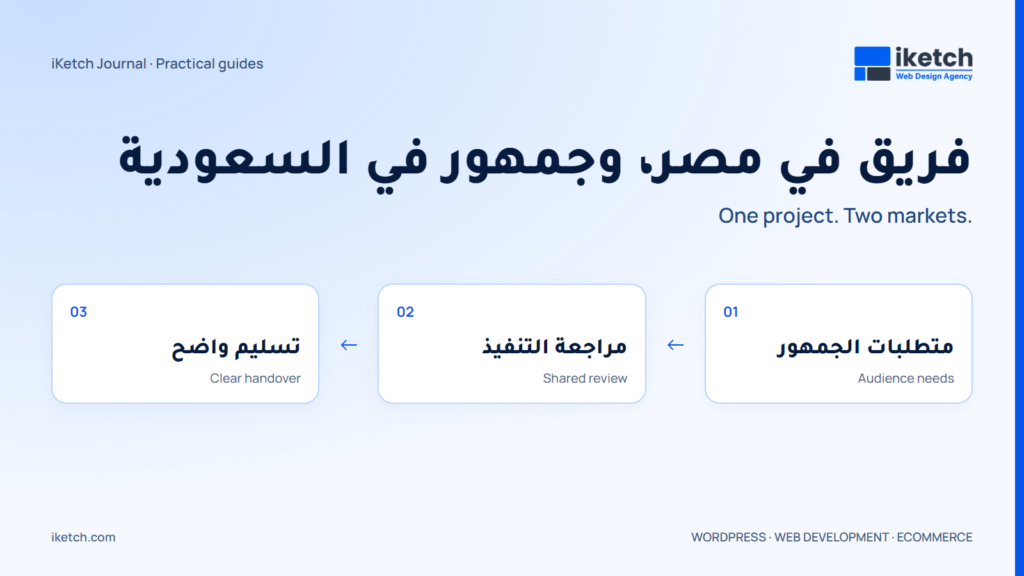
If your business operates in Saudi Arabia and you’re considering a web development team in Egypt, the first question may be about cost. But once you compare proposals, other questions matter just as much. Does the team understand your customers? How will you review work remotely? And who will look after the website once it’s live?
Building a website for a Saudi business with a team in Egypt isn’t difficult simply because of the distance. Meetings, files and testing can be handled remotely. The real challenge is turning a request like “we need a professional website” into clear pages, features, approvals and delivery milestones.
At iKetch, we’ve worked on projects aimed at Saudi customers. That experience makes us pay attention to details that can look minor at first. Is the visitor looking for a product or service? Do they need a fixed price or a quotation? And is the Arabic mobile experience as clear as the desktop version?
Start with your Saudi customers before choosing a design
Imagine a supplies company offering dozens of products with specifications that vary by order. A conventional shop with a checkout could force buyers through steps that don’t fit the sales process. A well-organised catalogue and a “Request a Quote” button may be a better fit.
A store selling fixed-price items, meanwhile, needs a clear journey from selecting a product to payment and delivery. A service business may primarily need to explain its expertise and encourage enquiries.
Before designing the homepage, identify who will visit, what they need to achieve and the action you want them to take. Our Leopard Catering project is an example of work for a business operating in Saudi Arabia. Explore how its services are presented and compare that approach with your needs.
What should you agree on before development begins?
Many avoidable problems start with vague requirements. “The website should be in Arabic and English” doesn’t say who writes the copy or approves the terminology. “It should be scalable” doesn’t explain which features are included in the quote.
Start with a short brief that answers five questions:
- Website type: A service website, catalogue with quote requests or eCommerce store?
- Content: Who provides descriptions, product images, credentials and approved information?
- Languages: Is Arabic primary? Who reviews the English content and product terminology?
- Features: Do you need forms, WhatsApp, customer accounts, payments, shipping or an external integration?
- Management: Who will update pages and products after launch?
For an online store, confirm which payment and shipping services are available to your business in Saudi Arabia, including their activation requirements, before designing checkout. A payment option working in a demo does not guarantee that it can be activated for your merchant account.
How do you manage a project from Saudi Arabia with a team in Egypt?
Egypt and Saudi Arabia are close in time zone, and speaking Arabic can simplify discussions. Still, decisions get lost in scattered WhatsApp calls and messages. Appoint one person in your company to consolidate feedback and one project contact on the development team.
Break delivery into stages you can inspect: page structure, an initial design, development of pages and features, then testing. Keep feedback in one document or tracker at each stage.
Instead of saying “make this page look more premium”, try: “On mobile, customers have to scroll several times before seeing the quote request button. We need that action near the top of the product page.” That’s a problem the team can investigate and a result you can verify.
Agree early on what counts as a revision versus a new feature. Adding an information page isn’t the same as building a pricing engine or an ERP integration, even when the idea comes up during development.
An Arabic website is more than translated text
If your audience is in Saudi Arabia, the Arabic experience belongs in the design process. Right-to-left layout, navigation order, buttons, form fields and the presentation of numbers and specifications all affect usability.
Language switching should work beyond the homepage. Someone may arrive from Google on an Arabic product page, switch to English and end up back on the homepage—or on a page with different information.
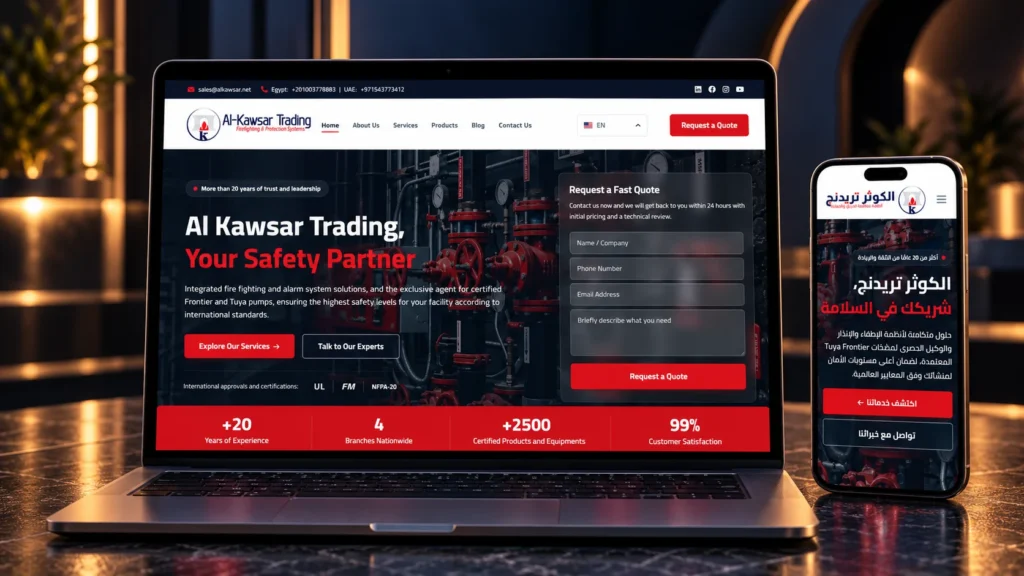
Our Al-Kawsar Trading case study covers a multilingual iKetch project. It offers an example of content organisation and navigation. Your business should still assign someone to approve terminology and final text before publication.
Test the website yourself before accepting delivery
Don’t rely only on screenshots or an “everything works” message. Open the site on your phone and follow the steps a customer would take. Find a service, open a product, use navigation and contact the business.
If the site receives enquiries or orders, test a complete journey in an appropriate test environment. Confirm that the right person receives the message and the details are correct. A form’s success notification alone doesn’t prove your sales team received anything.
Your final review should include:
- Mobile and desktop, especially important internal pages.
- Arabic and English content and links between matching pages.
- Forms, email, WhatsApp and contact numbers.
- Images and loading performance, using PageSpeed Insights to investigate problems.
- Editing a page or product through an account owned by your team, not only the developer’s account.
You can also explore our Leopard Sweet project. Just remember that a store’s appearance and verified operation of orders and payments are different things.
After launch, what does your company own?
The final delivery meeting isn’t the end of your website’s life. Make sure the domain and essential accounts are registered to your company, and understand who manages hosting, email, backups and updates. Ask for a practical content-management walkthrough, and agree on the support period and what’s included.
Clarify ownership of the theme, files and licences, and how future changes will be requested. At iKetch, we build custom WordPress themes and offer ongoing technical support, but the precise handover and support arrangements should be documented in each project proposal.
Should you hire a team in Egypt for your Saudi website?
The right decision isn’t simply about geography or the lowest quote. Compare previous work, the team’s understanding of your customers, how reviews are managed, and how the site will be tested and handed over. A team that explains its decisions and scope is easier to evaluate than a proposal filled with broad promises.
If you’re planning a website for a Saudi business, explore our WordPress development service and iKetch portfolio. Then contact us with a short description of your business and the website you need. We can discuss the pages, features and delivery approach before defining the scope.