
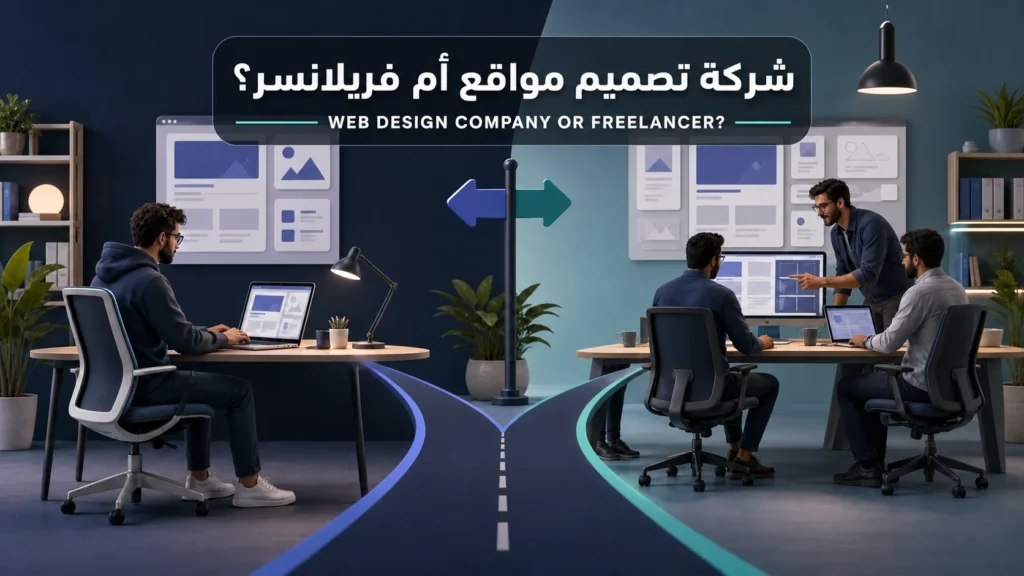
Choosing who will build your website is not simply a matter of comparing two prices. A lower quote may suit a small project, or it may leave management, content, testing, and handover to you. A larger quote may include useful coordination, or services you do not need.
A skilled freelancer can be right for focused work. A web design company may make more sense when disciplines, stakeholders, and integrations must move together. The useful question is which model fits your scope and the coordination you can manage internally.
Here is how to compare both options without assuming a default winner.
Web design company vs freelancer at a glance
A freelancer is an independent professional you hire directly. They may handle one specialist area, cover several parts of a small project, or bring in trusted collaborators. A web design company usually provides a managed process involving multiple roles, although the actual team and service scope can vary significantly between companies.
| Area | Freelancer | Web design company |
|---|---|---|
| Project management | Direct access to the person doing the work; management may be shared with the client | Often provides a defined contact and approval process |
| Specialist coverage | Strong fit for a clear task or a specific discipline | Better suited to work that requires coordinated disciplines |
| Flexibility | Often flexible for focused tasks and quick decisions | Depends on team capacity, process, and agreed scope |
| Continuity | Relies heavily on one person's availability | May redistribute work or provide cover within the team |
| Post-launch support | Depends on the agreement and future availability | May be part of launch support or a separate maintenance service |
| Cost structure | Can be leaner for a limited, well-defined brief | May start with a broader scope that includes management and several roles |
These are tendencies, not guarantees. An organised freelancer may deliver a better experience than a company with poor communication. A small specialist company may be more responsive than a loose group of contractors. Compare the people, scope, and working process behind the proposal rather than relying on the label.
Who will manage the project?
Direct communication is a strong reason to work with a freelancer. For a simple project with one decision-maker, speaking to the person doing the work can keep progress fast and clear.
The picture changes with several services, languages, integrations, or internal approvers. Someone must collect feedback, confirm decisions, and control scope. If you hire several specialists separately, you may become the project manager by default.
A company does not solve this automatically. Ask who your contact is, how feedback is documented, which reviews are included, and who approves each stage.
Our guide to the questions to ask before hiring a web design company can help you examine the process behind a proposal, not just the portfolio.
Does the website need one specialist or a coordinated team?
Not every website requires a large team. One professional may handle a landing page with approved content and a clear setup. A multilingual company site, store, or custom workflow usually creates dependencies between disciplines.
Break the project into responsibilities:
- Who translates business goals into a useful page structure and visitor journey?
- Who designs the interface across desktop and mobile states?
- Who develops the website and configures content management and integrations?
- Who prepares and reviews content in each language?
- Who tests forms, permissions, handover, and third-party services?
- Who investigates an issue when the cause sits between hosting, code, and an external platform?
If one person can own the scope, extra roles may add needless overhead. If the work must be divided, compare coordinating specialists yourself with hiring a website design and development service responsible for the combined outcome.
Continuity and changes during the project
Website projects rarely reach launch unchanged. Content may arrive late, a stakeholder may request another page, or an integration may behave unexpectedly. How these changes are handled matters.
Ask whether a scope change receives a separate estimate, whether approved requirements are recorded, and how a revision differs from a new feature. “Unlimited changes” does not explain how time or priorities will be managed.
A freelancer's availability can become a bottleneck; a larger team can also slow decisions when ownership is unclear. In either case, changes should be described, assessed, approved, and scheduled.
Ownership, accounts, and handover
Ownership questions are often postponed until launch, when clients discover that a domain, licence, or source file was never included in the agreement.
Whether you choose a company or a freelancer, agree who owns and controls:
- The domain and hosting account.
- WordPress administrator or platform owner access.
- Design files and original assets included in the project.
- The code repository, website files, and database copy where relevant.
- Licences for themes, plugins, fonts, and paid services.
- Analytics, email, form, and third-party integration accounts.
Define the handover format too: production migration, credentials, assets, basic documentation, and any team orientation included.
These items belong in the commercial scope. Our article on company website cost and what a professional quote should include helps compare scope rather than headline price.
What happens after launch?
Launch support normally covers implementation issues for a defined period. Ongoing maintenance may include updates, backups, monitoring, content work, or further development under a separate agreement.
Do not assume that every company offers unlimited support, or that a freelancer will become unavailable as soon as the final invoice is paid. Ask about the support period, communication channel, expected response, and which requests will be treated as new work.
A later problem may involve hosting or a third-party service rather than the original code. Someone still needs to diagnose it. Read why ongoing technical support matters after launch before deciding what coverage you need.
When is a freelancer the right choice?
A freelancer is often a strong fit when one person can own the work from start to finish: implementing an approved design, building a feature, improving an existing site, or delivering a small website.
The arrangement is more likely to work well when:
- You can describe the required output clearly.
- Your team can review work and make decisions without a long approval chain.
- You are prepared to coordinate any additional specialists.
- The freelancer has relevant examples for the scope, not only an attractive general portfolio.
- Both sides document milestones, ownership, handover, and support.
In this situation, direct access and a lean working relationship may be exactly what the project needs.
When is a web design company the better fit?
A company becomes more useful when one party must coordinate a broader outcome, such as a multilingual site, ecommerce project, custom integration, or several internal approvers.
A web design company may be a better fit if:
- Design, development, content, and integrations must follow one plan.
- You do not have an internal project manager to coordinate separate suppliers.
- Continuity and post-launch responsibility are important to the business.
- The project requires documented stages, approvals, and structured handover.
- A delay in one discipline would affect a campaign, launch, or business process.
“Company” is not evidence of capability. Check who will do the work, how quality is reviewed, and whether the team has relevant experience. These are central to choosing the right web design company.
Seven questions to answer before you choose
Write an initial answer to these questions before requesting proposals:
- What is the actual scope? List pages, languages, features, integrations, and available content.
- Who will perform each part of the work? Look beyond the supplier name and clarify real responsibilities.
- Who will manage feedback and approvals? Identify one contact on your side and one on the delivery side.
- What will you own at handover? Specify accounts, files, licences, access, and documentation.
- How will changes be handled? Agree on the difference between a revision and a scope change.
- What support is included? Define the period, channel, and boundaries of post-launch support.
- Which recurring costs should you expect? Ask about hosting, licences, maintenance, and external services.
Then compare every proposal against the same list. A lower quote may exclude content entry, testing, migration, or support. A larger one may include services your team can already provide. A useful comparison exposes these differences before the contract is signed.
Choose the model that fits the scope
There is no universal winner. If the task is focused, the required expertise is clear, and your team can manage decisions directly, a specialist freelancer may be the most efficient choice. If the project combines several disciplines, stakeholders, and operational dependencies, a web design company may offer the coordination and continuity you need.
Define the scope, responsibilities, ownership, and support first. Then evaluate the people, process, and written proposal behind each option. That leads to a decision based on the realities of your project rather than price or label alone.
If your website needs several disciplines or you are still shaping the scope, discuss your project with iKetch and request a clear proposal covering delivery stages, handover, and support.